
Treatment concept
We clearly present how the MozgásPiramis®–based treatment is structured, step by step.
The steps of the Movement Pyramid® treatment concept:
1.
Regardless of the type of complaint, every patient begins with a comprehensive initial assessment at their first visit.
2.
The assessment is carried out based on the MozgásPiramis® concept developed by Rita Szentiványi, using a structured evaluation and analysis process.
3.
During the examination, we perform evidence-based, standardized manual and functional orthopedic tests.
4.
Based on the symptoms and test results, we determine the patient’s position within the MozgásPiramis® framework.
5.
Following this, we prepare a personalized therapeutic recommendation tailored to the patient’s condition.
6.
With us, the assessment is not a separate step: therapeutic treatment already begins during the first session.
Are you ready to start the therapy?
The MozgásPiramis®
The goal of the therapy is never merely the relief of acute pain. While pain reduction can be the first step, the objective is not symptomatic treatment, but addressing or eliminating the underlying causes. The ultimate goal of the therapy is recovery.
As you progress upward through the levels of the MozgásPiramis®, the therapy evolves accordingly: following pain relief, mobilization takes place, then stabilization, and only after that do general muscle strengthening and endurance improvement follow.
In practice, this means a few sessions of manual therapy, followed by physiotherapy. After that, movement forms that increasingly resemble training are introduced, and finally functional training is applied. At this stage, the exercises are very similar to what you would do with a personal trainer—however, here you work with a qualified healthcare professional who is fully aware of your injury and symptoms, knows exactly how far you can be safely loaded, and guides you in a hygienic healthcare facility, in a small-group setting.
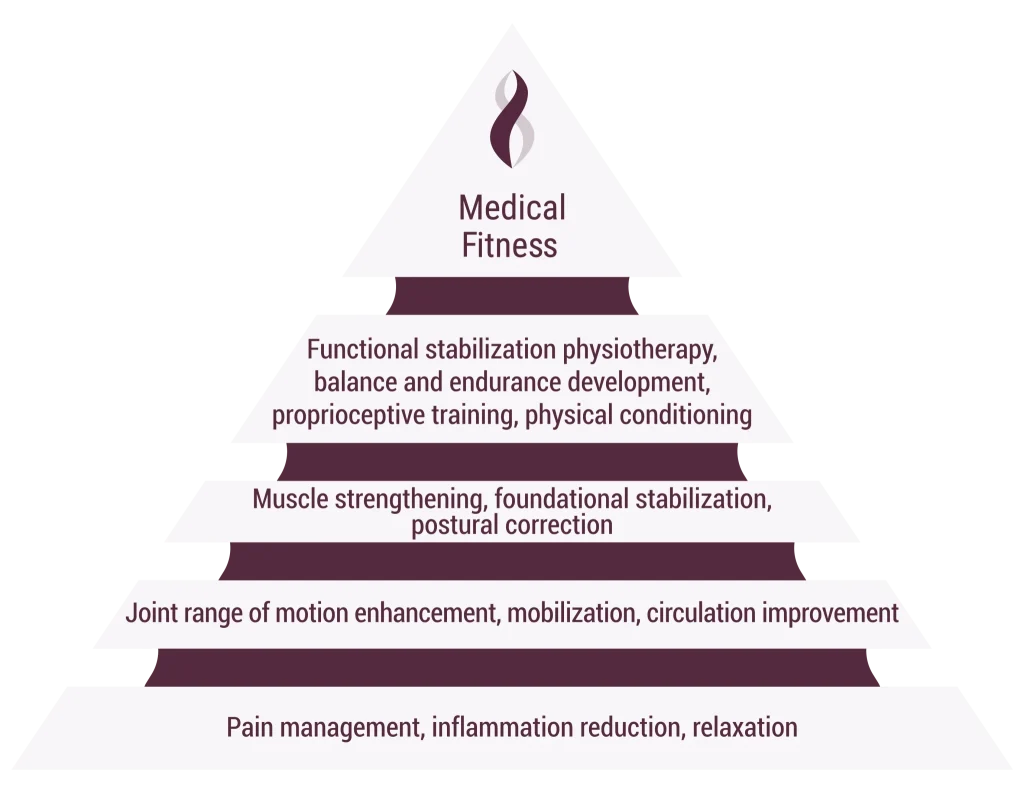
The 5 levels of the MozgásPiramis®
1. LEVEL
With the help of manual therapy, we identify which tissue structure or joint the pain originates from, in order to find the root cause of the problem. We work on restoring ligaments, joints, muscles, and fascia using scientifically grounded methods. Our therapists all hold degrees from accredited colleges or universities, and after joining us, they complete thorough internal training where they become familiar with our therapeutic concept.
The primary goals at this stage are pain relief and improving circulation. Tissue regeneration starts quickly, and this process can be accelerated with connective tissue manual therapy and physiotherapy. At this level, symptoms often begin to ease after just a few sessions and may even disappear completely. However, this is only the beginning of the journey. Continuing treatment at this point is essential to ensure lasting results.
International research also confirms what we have experienced in practice: this stage has the highest dropout rate from therapy, which often leads to the recurrence of symptoms. Many people make the mistake of stopping treatment too early—and in many cases, the therapist does not emphasize strongly enough or often enough that continuation is crucial—even though this is where real, long-term progress could be achieved.
If the goal were only to eliminate symptoms, a few painkillers might often be enough, as the inflammation would subside. But recovery requires more than that. Manual therapy not only achieves pain reduction, but also prepares the body for progress by restoring proper joint positioning. However, this requires consistency and continuation.
In line with international research, the MozgásPiramis® concept prescribes 12 sessions at this first level, with two therapy sessions per week. This typically consists of a roughly equal combination of manual therapy and physiotherapy, often supplemented with physical therapy modalities such as ultrasound, shockwave therapy, kinesiology taping, and others.
2. level
You cannot move properly while in pain. However, once pain is reduced, proper joint mobility becomes achievable, along with the correct range of motion, flexibility, and the healthy elasticity of muscles, nerves, and connective tissues. Effective strengthening is only possible through a full range of motion and with correct posture.
3. level
The joint mobility achieved through manual therapy, as well as the optimal contact of joint surfaces, can be maintained through the stabilizing functions of the muscles. With targeted physiotherapy exercises, the deep muscles surrounding the joints and vertebrae can be strengthened.
The next step (also consisting of 12 sessions) is already fully centered on the patient’s active participation, as at this stage we can typically continue joint mobilization and stabilization with only mild symptoms—or with the patient being completely symptom-free.
4. LEVEL
Functional exercises, complex muscle strengthening, agility drills, and plyometric tasks are applied at this stage. Here, we already expect fast reactions from the joints and muscles. Muscle tone development becomes clearly visible, muscular balance is restored, and posture improves.
5. level
This stage is medical fitness, which focuses entirely on strength building and endurance improvement, carried out in a professional healthcare environment using medical-grade equipment, under the supervision of a healthcare professional—or, in the case of athletes, through sport-specific training aimed at returning to their sport.